Most people didn’t notice it at first. No big headlines. No viral posts saying “everyone is going back to church.” Nothing like that. It just… started showing up in small ways. A friend mentioning they went last Sunday. Someone else saying they’ve been going “on and off.” Not committed. Not making a big deal out of it. Just… going. And if you try to understand why more Americans are returning to church in 2026, the obvious explanation — religion — actually explains very little. That part surprised me too.
It’s not about belief. It’s more like… something feels off
I keep hearing the same sentence, just phrased differently.
“Something’s missing.”
Not in a dramatic way. Nobody’s saying their life is falling apart. It’s more subtle than that.
Everything is… fine. Work is stable. Life is moving. Weekends are busy enough.
But it doesn’t feel right either.
There’s this low, constant mental noise. Like you’re always half-distracted, even when you’re supposed to be relaxing.
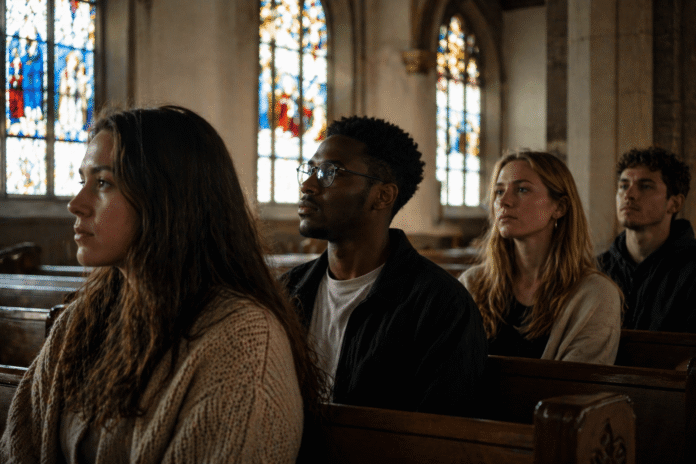
And then people walk into a church — sometimes randomly, sometimes because someone invited them — and for an hour, that noise drops.
Not completely. But enough to notice.
And that’s usually what brings them back.
Burnout didn’t go away. It just became normal
A few years ago, everyone was talking about burnout like it was this big crisis.
Now? People don’t talk about it as much.
Not because it’s gone. Just because… people got used to it.
That’s the uncomfortable part.
People tried fixing it. Different routines, better boundaries, apps, therapy, breaks, all of it.
Some of that helps, sure.
But there’s still this underlying feeling of always being “on.” Even when you’re not working.
Church feels different from that.
It’s one of the few places where doing nothing isn’t seen as wasting time.
You sit. You listen. Or you don’t listen. Nobody checks.
There’s no output expected from you.
That’s rare enough now that people are starting to value it more than they expected.
The loneliness thing… it’s bigger than people admit
This is probably the biggest reason behind why more Americans are returning to church in 2026.
But almost nobody says it directly.
Because saying “I feel lonely” still feels uncomfortable.
So it comes out sideways.
“I just wanted to get out of the house.”
“I missed being around people.”
“I didn’t want another weekend on my phone.”
That last one — you hear that a lot.
Church gives people something very basic that’s weirdly hard to find now: the same group of people, in the same place, at the same time.
Every week.
It’s predictable. A little boring, even.
But that predictability is exactly what people are missing elsewhere.
Online interaction is constant, but it doesn’t stick. It resets every day.
This doesn’t.
Younger people are showing up… but not in the way you think
This part gets misunderstood a lot.
People see younger faces in churches and assume it’s some kind of return to tradition.
It’s not that simple.
A lot of them aren’t fully “in.” They’re not suddenly deeply religious.
They’re curious. A bit skeptical. Sometimes they disagree with what they hear.
And they still come back.
Why?
Because everything else feels… loud.
Your life is online. Your thoughts are online. Even your personality starts to feel like something you’re presenting.
Church — at least some of them — feels like a place where you don’t have to perform that.
You can just sit there and not explain yourself to anyone.
Honestly, that’s a bigger draw than belief for a lot of people right now.
Churches didn’t transform overnight, but they’re not the same either
If you’re imagining exactly what church felt like 20 years ago, that’s only half true.
Some of them are still very traditional.
But others have shifted in small ways. Not loud changes. You wouldn’t notice from the outside.
It’s more in how people talk. What they focus on.
There’s more space for real-life stuff — stress, anxiety, relationships, confusion about where life is going.
Less “here’s what you should be doing,” more “yeah, life is messy.”
Also, people don’t rush out the second it ends anymore. They hang around. Talk. Sometimes awkwardly, sometimes not.
That lingering part matters more than it seems.
It almost feels like going against the flow now
This is the weirdest shift.
Going to church used to be normal. Then it became outdated.
Now it kind of sits in this space where it feels… slightly rebellious again.
Not in a dramatic way. Just quietly.
Everything else in life is fast. Reactive. Always updating.
You’re expected to respond, share, react, improve — constantly.
And then there’s this one place where none of that is required.
You don’t have to prove anything there.
That contrast hits harder than people expect.
This isn’t a big comeback. It’s something slower than that
If you’re expecting a clear trend line, like numbers suddenly jumping — you probably won’t see it.
That’s not how this is happening.
It’s slower. More individual.
Someone goes once. Then again a few weeks later. Then maybe they start going more regularly.
No announcement. No “I’ve changed” moment.
Just small, quiet decisions.
And those tend to stick more than the big, dramatic shifts anyway.
So yeah, when people ask why more Americans are returning to church in 2026, the answer isn’t neat.
It’s not just about religion.
It’s about people trying to deal with something that doesn’t have a clear name.
A mix of noise, fatigue, loneliness… maybe even boredom with how everything works now.
Church just happens to offer a pause from all that.
Not a solution. Not a fix.
Just a pause.
And right now, that seems to be enough.
FAQs
Are Americans actually becoming more religious again?
Some are. But a lot of people are just exploring or reconnecting without fully committing.
Why are young people interested in church now?
Less about belief, more about wanting a space where they don’t have to perform or be online.
Is this happening everywhere in the U.S.?
Not evenly. Some communities are seeing it more than others.
Will this trend last?
Hard to predict. But slower, quieter changes like this usually don’t disappear quickly.