
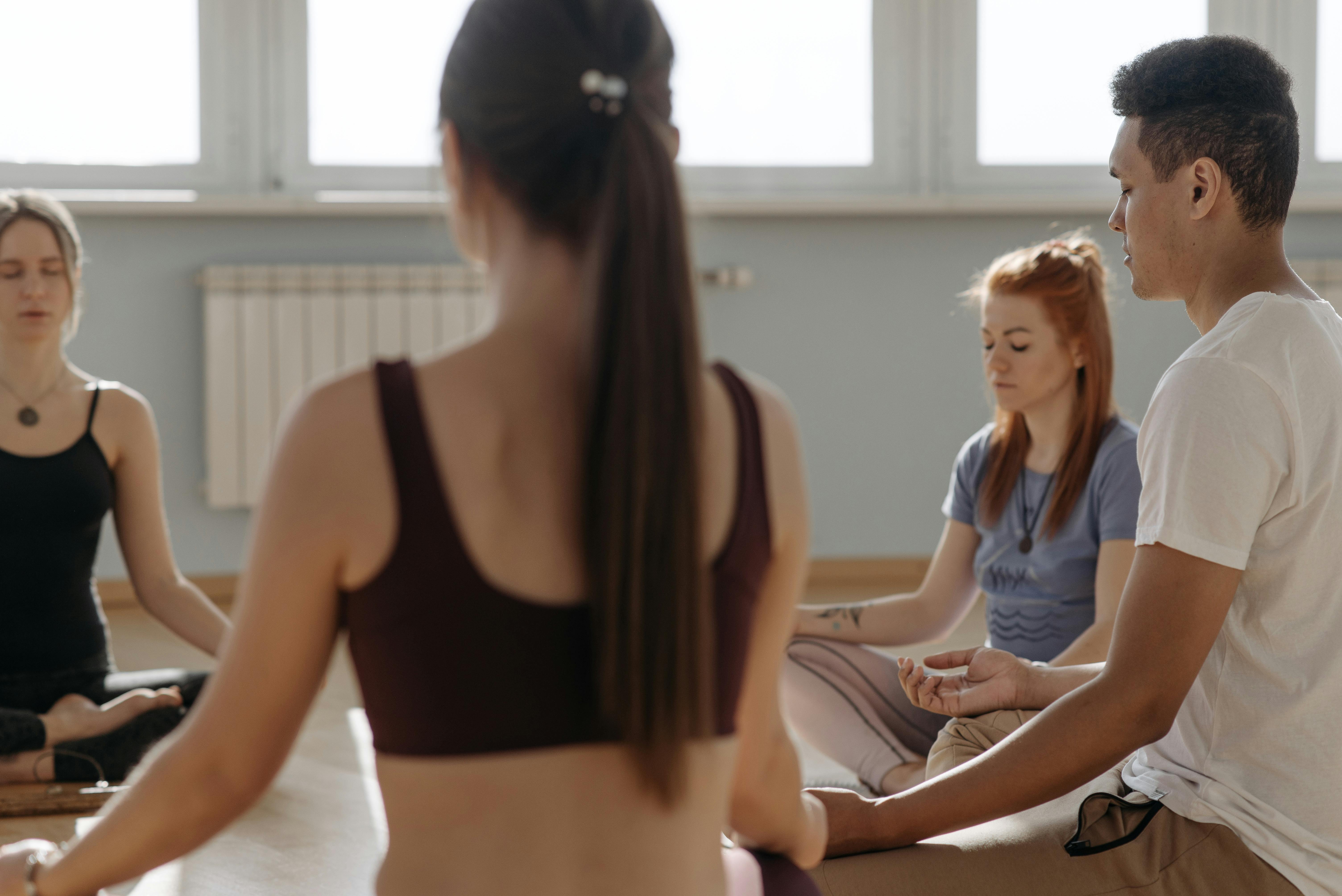
Most Americans who meditate learned from a recording rather than from a person sitting in front of them. That substitution changes what the instruction can and cannot do.
Guidance was always partly verbal
Meditation instruction has long been delivered by voice. A teacher speaks a few sentences, the student practices, and the teacher speaks again when something needs adjusting.
Recording captures the first half of that exchange faithfully. The words are the same, the pacing can be better rehearsed, and the delivery does not vary with the teacher's mood.
What recording cannot capture is the second half, in which the instruction changes because of what the teacher observed. The recorded voice speaks to a generic student.
The correction loop is what goes missing
In person, a teacher notices a slumped posture, a held breath, or the particular way a student describes their difficulty, and adjusts the next instruction accordingly.
A recording offers the same words to a beginner straining for concentration and to someone who has practiced for years. Both hear an instruction calibrated to neither.
Some people supply their own correction by comparing their experience to the description and adjusting. Others repeat an unproductive habit for a long time without knowing it.
Availability changed who starts
Before recordings were common, beginning meditation usually meant finding a group, traveling to it, and being visible while doing something unfamiliar. That filtered out many people.
A recording removes every one of those costs. Practice can begin privately, at any hour, and can be abandoned without anyone knowing it was attempted.
The result is a far larger and more varied population of beginners than teaching in rooms ever produced, including many who would never enter a meditation center.
Format shapes the practice that spreads
Recorded sessions are usually short, self-contained and pleasant to complete, because those qualities keep listeners returning. Length and difficulty are shaped by that pressure.
Practices that are uncomfortable in the early stages, or that require weeks before anything is noticeable, are harder to deliver in this format and are therefore less represented.
What spreads most widely is calming and body-focused instruction, while the more austere concentration and insight disciplines remain largely in retreat and teacher-led settings.
Where the two forms are combined
Many centers now use recordings for daily practice and reserve human teaching for periodic interviews, retreats, and questions that a recording cannot anticipate.
That division treats the recording as a rehearsal tool rather than as a replacement teacher, which matches what the technology does well.
It also acknowledges an old idea in contemplative traditions: instruction becomes precise only when someone who knows the territory can see where a particular student actually is.