
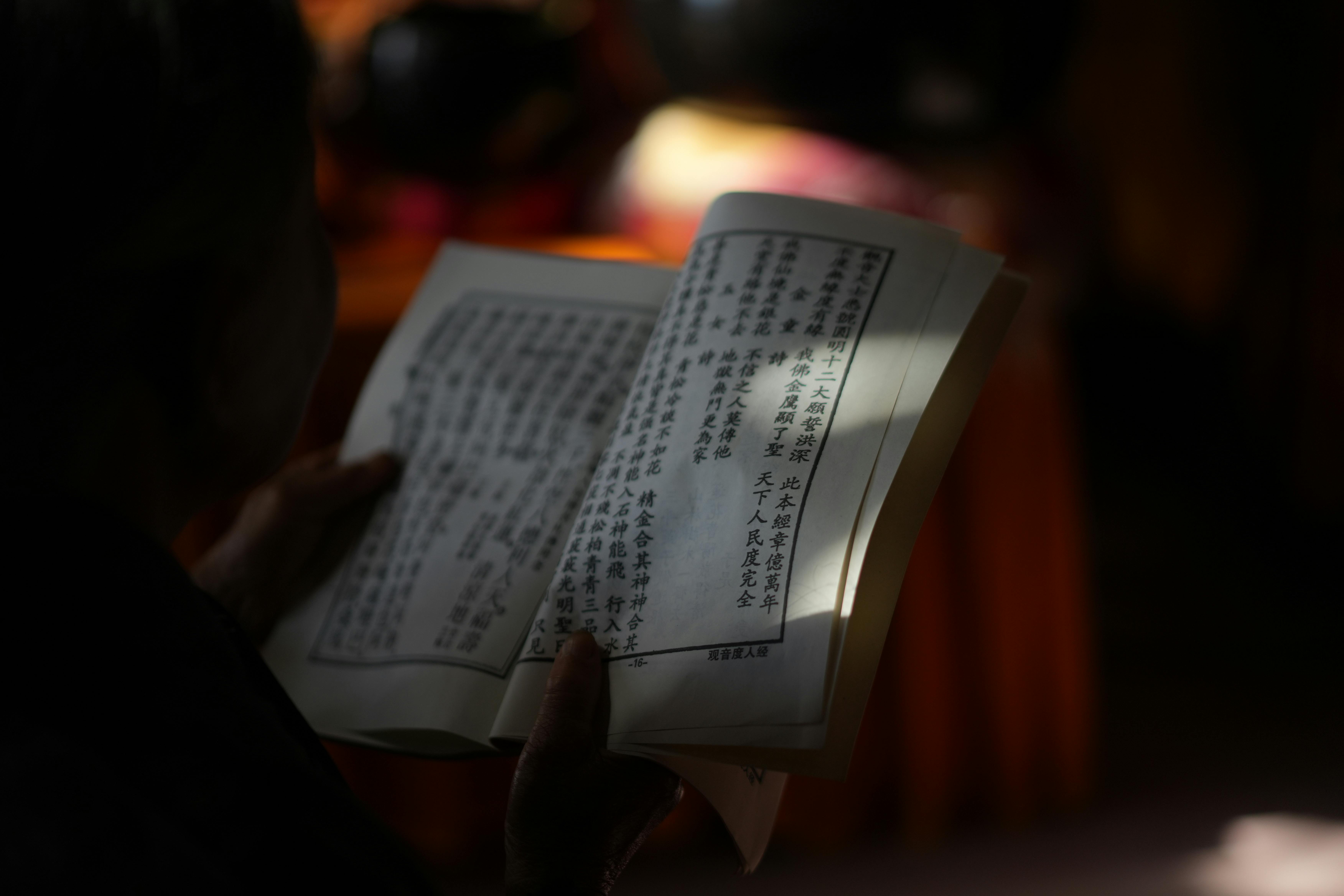
Most American readers meet the Bhagavad Gita, the Dao De Jing or the Buddhist suttas in English. The text they encounter carries the fingerprints of whoever rendered it.
The earliest translators had a particular training
Many early European and American translators of Asian scripture were trained in classical languages and biblical scholarship, and worked with those categories in hand.
They frequently reached for vocabulary already loaded with Christian meaning, rendering unfamiliar terms as sin, soul, salvation, grace or scripture.
Each of those choices imports assumptions. A term with no equivalent doctrine behind it can arrive in English sounding like a familiar theological claim.
Style choices changed the perceived genre
Some translators used archaic English, with older pronouns and inverted syntax, because that register signaled sacredness to their readers.
The effect was to make texts of very different original character sound uniformly solemn, flattening distinctions between argumentative treatises, poetry and manuals of instruction.
Later translators moved toward plainer prose, and passages that had sounded oracular for a century began to read as practical or even technical.
Selection mattered as much as wording
Anthologies and popular editions rarely present complete works, and the passages chosen tend to be those that are portable, quotable and agreeable to the intended audience.
Sections dealing with ritual detail, caste and social regulation, cosmology or polemic against rival schools are often abridged or omitted from popular editions.
Readers therefore encounter a version already curated toward universal moral counsel, which is one reason the traditions can appear more similar to each other than they are.
Some renderings are adaptations rather than translations
A number of widely circulated English versions were produced by writers working from other English versions rather than from the source language.
These are better described as interpretations. They can be beautiful and useful, but they cannot be relied on for what a particular line actually says.
Editions usually indicate their method in a preface, and comparing two independent scholarly translations of the same passage will quickly reveal where interpretation is doing the work.
Why the early versions still dominate
Older translations are out of copyright, which makes them free to reprint, quote and post, so they circulate far more widely than newer scholarly editions.
Quotations that spread across posters, greeting cards and social feeds are typically drawn from that public-domain layer, and are sometimes altered further in transmission.
A phrase that sounds ancient may be a nineteenth-century English stylistic decision, which is worth knowing before building an argument on its precise wording.
Scholarly editions address this by keeping key terms untranslated and explaining them in notes, which reads awkwardly but leaves the interpretive work visible rather than hidden inside the sentence.