
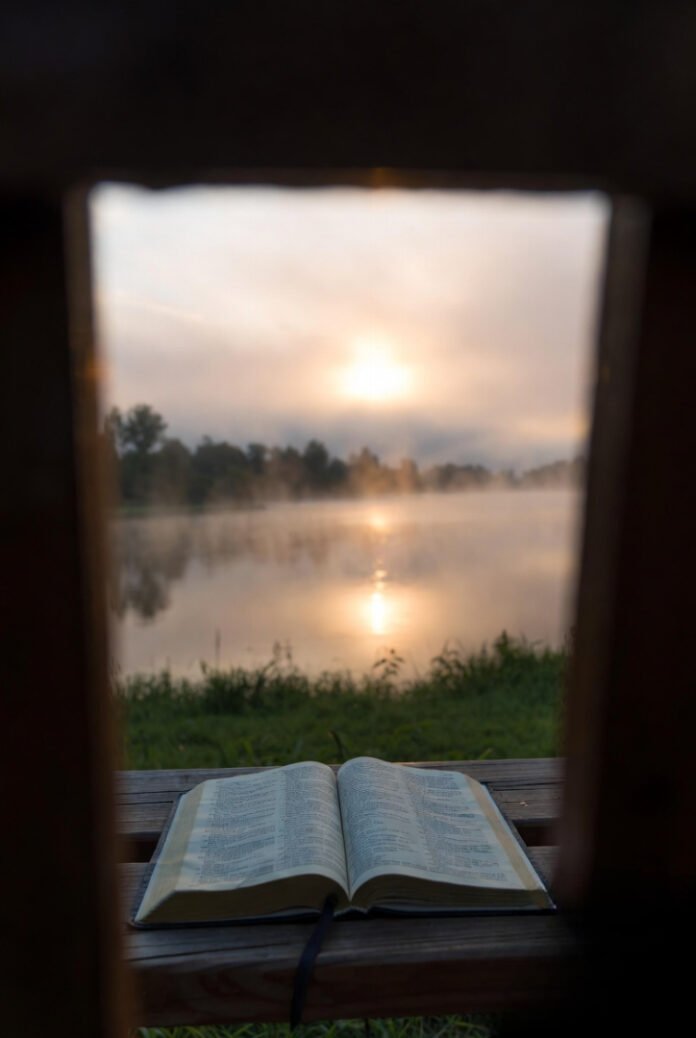
“Be Still and Know That I Am God.”
I used to think that verse was basically God saying, “Calm down.”
Which—honestly?—is not super helpful when you’re spiraling at 1:13 AM because your brain has decided now is the perfect time to replay every awkward thing you’ve said since 2007.
The first time I remember really noticing Be Still and Know That I Am God was during a chaotic season. Job uncertainty. Family stress. The kind of week where your coffee goes cold three times because you keep getting interrupted.
Someone texted me the verse. Just that. No explanation.
And I remember thinking, “Okay but HOW.”
How do you “be still” when your mind is doing jumping jacks?
Where This Verse Actually Comes From
The line “Be still and know that I am God” comes from Psalm 46 — specifically Psalm 46:10.
And here’s what’s wild.
Psalm 46 is not peaceful spa music vibes.
It talks about mountains falling into the sea. Earth giving way. Waters roaring.
It’s chaos.
It’s basically the Old Testament version of your group chat exploding during a crisis.
And right in the middle of all that noise?
“Be still, and know that I am God.”
That changes the tone a little, doesn’t it?
This isn’t a verse whispered during a quiet picnic.
It’s spoken into disaster.

H2: What “Be Still” Actually Means (Hint: It’s Not Just Sitting Quietly)
For years, I thought “be still” meant:
- Sit quietly
- Stop moving
- Lower your voice
- Maybe light a candle if you’re feeling extra spiritual
But when you dig into the original meaning, “be still” is closer to:
Stop striving.
Release your grip.
Let go.
It’s less about physical stillness and more about surrender.
Which is… uncomfortable.
Because I like striving.
Striving makes me feel productive.
If I’m anxious about something, I want to do something.
Research it. Fix it. Text someone about it. Make a spreadsheet about it.
(Please tell me I’m not the only one who stress-organizes.)
But this verse says:
Stop.
Not because you’re lazy.
Because God is God.
And you are not.
Ouch.
H3: “Know That I Am God” — Not Just Cute Wall Art
We’ve all seen it.
That rustic farmhouse sign that says “Be Still and Know” in cursive script.
Very Pinterest.
But the second half of the verse matters.
“Know that I am God.”
It’s not just about calming down.
It’s about remembering who’s in control.
There’s something grounding about that.
When everything feels unstable—economy, health, relationships—this verse pulls your focus back.
It’s like God saying:
“You see the waves. I see the whole ocean.”
And honestly? I need that reminder daily.
Hourly, sometimes.
The Time I Totally Missed the Point
I’ll tell you a quick story.
A few years ago, I was obsessing over a decision. Like, deeply obsessing. I made pro/con lists. Asked five different people for advice. Changed my mind every 48 hours.
My wife finally looked at me and said, “You seriously thought worrying this much was helping?”
Rude.
Accurate.
I was trying to control an outcome that wasn’t fully mine to control.
That’s when Psalm 46:10 hit differently.
“Be still.”
Translation: Stop white-knuckling the steering wheel.
“Know that I am God.”
Translation: You don’t have to carry this alone.
H2: Be Still and Know That I Am God in Real Life (Not Just Church Life)
Let’s bring this down to earth.
This verse matters when:
- Your medical test results are pending
- Your kid is struggling and you don’t know how to fix it
- Your bank account looks… concerning
- You feel like you’re falling behind everyone else
Being still doesn’t mean you stop acting responsibly.
It means you stop acting like you’re sovereign.
That word sounds dramatic. But think about it.
How often do we operate like it’s all on us?
Like if we don’t hold everything together, it will all collapse?
That’s exhausting.
This verse interrupts that narrative.
A Little Theology Without the Boring Part
In Psalm 46, the writer describes God as a refuge and strength. A very present help in trouble.
Not a distant observer.
Not a cosmic “good luck.”
A present help.
And then comes the command: Be still.
It’s almost like:
“Because I am your refuge… you can unclench.”
That’s different from:
“Unclench first, and then I’ll show up.”
See the order there?
God’s presence comes first.
Stillness flows from trust.
When I Absolutely Do NOT Want to Be Still
Confession time.
There are moments when I do not want to be still.
I want to rant.
I want to send the long text.
I want to win the argument in my head.
I want to refresh my email again and again and again.
And yet.
The times I’ve actually paused—like really paused—and whispered, “Be still and know that I am God,” something shifts.
Not always my circumstances.
But my posture.
It’s subtle.
Like turning the volume down on internal chaos by just a few notches.
H3: Trusting God in Chaos (Easier Said Than Done)
Trust is easy when things are stable.
When paychecks come on time.
When relationships are smooth.
When plans unfold neatly.
It’s harder when:
- The diagnosis changes
- The job offer falls through
- The friendship fades
That’s when “Be Still and Know That I Am God” feels less like décor and more like survival.
It’s choosing to believe God is steady even when everything else isn’t.
Pop Culture Moment Because Why Not
There’s this scene in a lot of disaster movies where everything is exploding and one character just stands there calmly, surveying the chaos.
I always thought that was unrealistic.
But maybe that’s the image here.
Not panic.
Presence.
Like in those quiet moments in The Chosen (if you’ve watched it) where Jesus just looks at someone and says almost nothing—but you feel the weight of it.
Stillness isn’t weakness.
It’s anchored confidence.
So… What Does This Verse Truly Mean?
If I had to sum it up without sounding like I swallowed a theology textbook:
“Be Still and Know That I Am God” means:
You can stop fighting for control.
You can release what’s crushing you.
You can trust that there’s a bigger hand holding the story.
It doesn’t promise easy.
It promises presence.
And honestly?
Presence is what most of us are desperate for.
If You’re in a Loud Season Right Now
Maybe this verse feels impossible.
Maybe your mind won’t slow down.
Maybe your situation is genuinely scary.
Start small.
Don’t force serenity.
Just pause for ten seconds.
Breathe.
Whisper the first half of the verse.
“Be still…”
Then the second.
“…and know that I am God.”
You don’t have to feel it instantly.
You don’t have to master it.
Just practice it.
Over and over.
Because sometimes stillness isn’t a one-time achievement.
It’s a daily return.
And if you’re anything like me—coffee-dependent, occasionally dramatic, prone to overthinking—you’ll probably need that reminder tomorrow too.
Good news?
It’ll still be there.